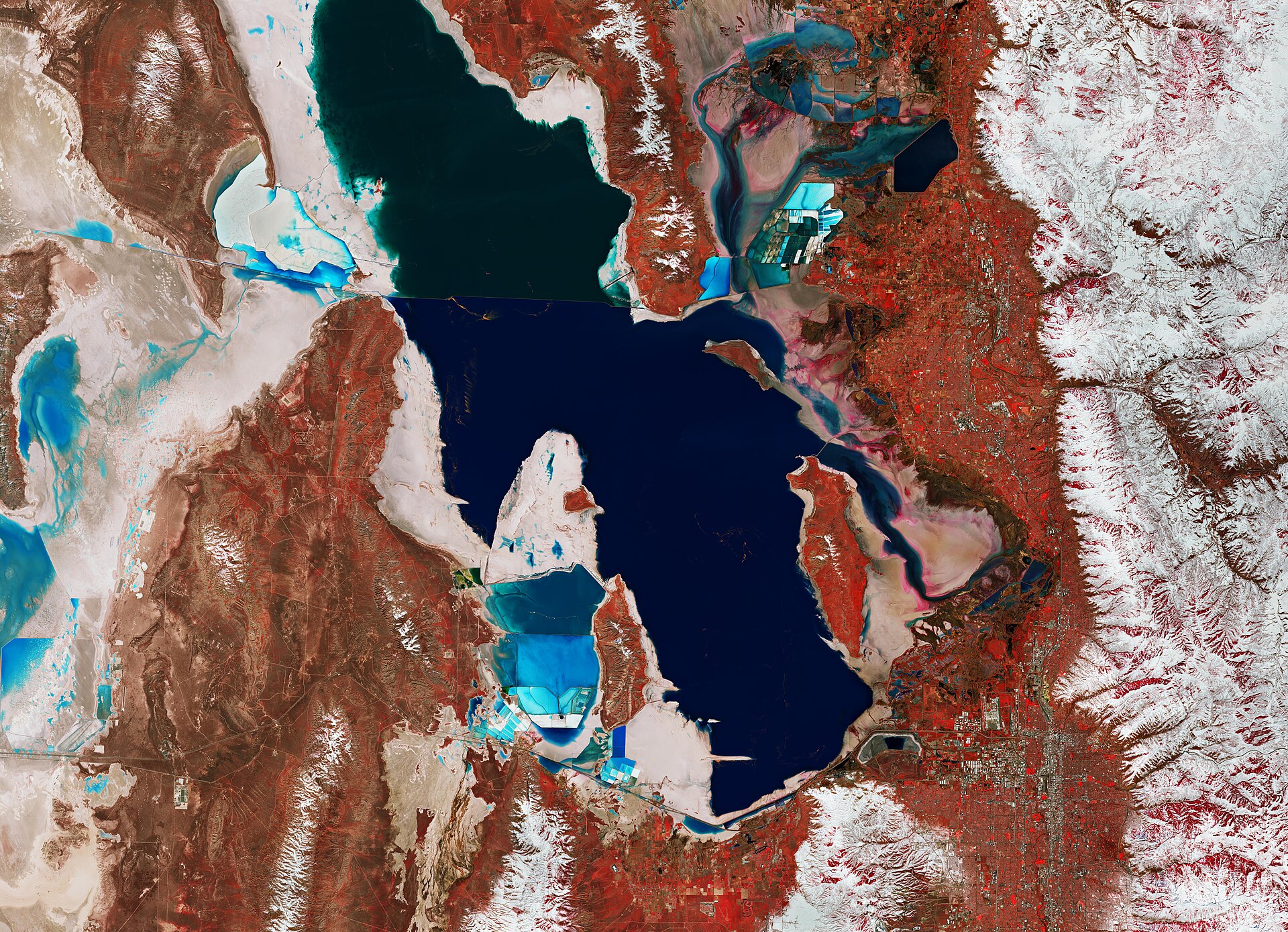
The lowest place on Earth is getting lower. The Dead Sea’s surface falls by more than a metre every year, its shoreline retreating from the hotels and biblical landscapes built along it, while thousands of sinkholes — some large enough to swallow roads — open in the exposed seabed as fresh groundwater dissolves buried salt. The cause is no mystery: the Jordan River, the sea’s historic feeder, is diverted almost in its entirety by the countries it passes, and mineral industries at the sea’s southern end evaporate much of what remains. The Dead Sea is a balance sheet of the region’s water use, rendered in salt.
The science of the decline is monitored obsessively — by geological surveys in Israel and Jordan and research consortia such as those coordinated through the US Geological Survey‘s international programmes — and it forecasts a sea that does not vanish but stabilises, eventually, at a far lower level, smaller and saltier, in a basin of hazards. What dies along the way is specific: freshwater springs and wetlands along the shore, the tourism economy built at the water’s edge, and a landscape of genuine antiquity. Environmental groups in all three riparian societies — Israeli, Jordanian and Palestinian — have campaigned jointly for decades, a rare consensus the politics above them rarely matches.
The Canal That Politics Built and Buried
The famous fix — a canal conveying Red Sea water north to the Dead Sea, generating power and desalinated water en route — has been studied, announced, scaled down and quietly shelved across twenty years, defeated by cost, environmental objections (mixing the two seas’ chemistries risks algal blooms and gypsum whitening) and the region’s diplomacy. Smaller schemes now dominate: water swaps in which Jordan receives desalinated water from the Mediterranean coast in exchange for solar power, partial restoration of Jordan River flows, and sinkhole-zone management that accepts the new shoreline. Water diplomacy reporting by the World Bank, which financed many of the studies, reads as an education in how shared rivers make neighbours of enemies. Follow regional coverage in our world section.
A Mirror for a Thirsty Region
Sinkholes: the Landscape’s New Hazard
The sinkholes deserve their own paragraph in the region’s story, because they are the crisis made sudden. As the sea retreats, fresh groundwater flowing towards it dissolves buried salt layers, and the ground above collapses without warning — more than seven thousand sinkholes are now counted along the western shore, with new ones opening monthly. They have swallowed roads, date plantations, a petrol station and sections of beach resorts, and they fence off widening zones of the shoreline behind warning signs. Engineers map them with satellite interferometry that detects ground sagging before it fails, converting surprise into forecast. The sinkholes are also, in their way, the most honest monument to the water crisis: a landscape physically restructuring itself around an absence, in a region where the politics of sharing water has been deferred longer than the geology can wait.
Tourism on the shrinking shore is adapting with a kind of grim ingenuity. Hotels built beside the water now run shuttle buses to beaches that migrate further away each year; spa towns market the mineral mud and the lowest air on Earth — oxygen-rich, pollen-poor, measurably kind to certain skin and lung conditions — as the sea itself becomes harder to reach. The industry’s long bet is that the name outlasts the geography. Underneath the adaptation runs the older truth the whole region shares: the Dead Sea is dying of decisions made far upstream, by people who will never swim in it, about rivers that never reach it. Its restoration, when the politics finally permits the engineering, will be the Middle East’s proof that a shared resource can survive its sharers.
The Dead Sea’s crisis is the Middle East’s water future arriving early: more people, less rain, rivers allocated beyond their flow. Its rescue, in whatever partial form, will be a template — of technical fixes made possible only by political ones. The sea itself is patient; it has been shrinking and recovering with climate for millennia. The question is whether the societies around it can cooperate faster than it falls. On the shore, the sinkholes keep their own counsel, opening one by one in the salt.